Wendy's
Wendy's Frosty Copycat Recipe
Malted milk powder and a deliberately under-frozen texture. Five minutes of work, four hours in the freezer, no machine.
 food.fast
Takeaway taste, kitchen prices
Wendy's Chili, and the Grilled-Beef Trick It Was Built Around
The texture nobody can reproduce with a pan of mince - and the reason is one step at the start.
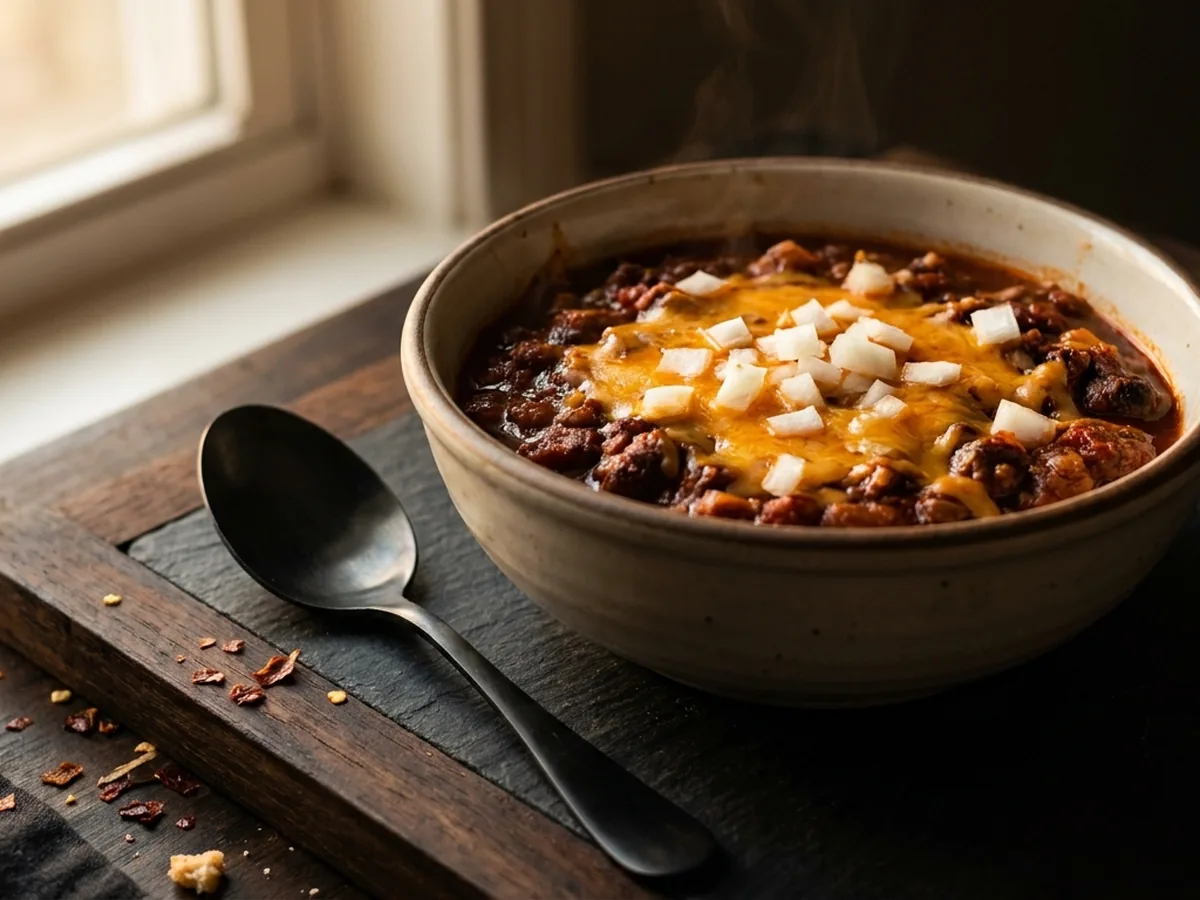
AI-generated illustration created for food.fast. It is not photographic evidence of a prepared batch.
This chili exists because of a waste problem. Wendy's grills fresh beef patties to order, patties that sit too long get pulled, and rather than bin them somebody decided to break them up into a chili. That origin story is well documented and it is also the single most useful fact about making it at home, because it explains the texture.
The beef in this chili is in irregular chunks, not fine crumbs. It has been cooked as a solid piece first, developed a proper browned crust, and only then been broken apart. Mince browned loose in a pan and simmered for an hour gives you fine, uniform grains - a perfectly good chili and a completely different one.
The rest of it is milder and sweeter than most people expect from something called chili. Tomato juice rather than stock, a spoon of sugar, chilli powder rather than chillies. It is a bowl of comfort food, not a test of endurance, and it is one of the genuinely great things any chain sells.
The method gives quantities, timings and observable cues rather than asking you to guess. The 6 cases in If it goes wrong explain likely causes and corrective action; 2 ingredient notes explain choices that materially affect the result.
See the recipe verification standard · See how the cost is calculated
Form the mince into four flat patties and cook them hard in a dry pan - three minutes a side, until each has a dark, properly browned crust. Then take them out, let them cool for a minute, and tear them into pieces the size of a thumbnail.
Three things happen that cannot happen any other way:
You get real Maillard browning. Loose mince in a pan releases water, steams itself and goes grey. A patty has a solid surface in contact with hot metal, so it browns. That browning is the entire savoury backbone of the chili.
You get irregular pieces. Torn beef has rough edges and varies in size, which is what gives the finished chili its texture. A spoon through it finds different things.
The pieces hold together through a ninety-minute simmer. Fine crumbs disintegrate into the sauce; thumbnail-sized pieces of browned beef survive and stay recognisably beef.
It adds about eight minutes to the recipe and it is the difference between "a good chili" and "that chili".
The liquid in this chili is tomato juice - the drinking kind, in a carton. That is unusual and it is central to how it tastes.
Tomato juice is thinner than passata, seasoned (usually with salt and a little celery), and considerably sweeter than tinned tomatoes. Building the chili on it gives a lighter, brighter, sweeter liquid than a stock-based chili, which is exactly the character this one has.
Using stock instead gives something deeper and more savoury that tastes like a good beef chili and not like this. Using only tinned tomatoes gives something thicker and more acidic.
If you cannot find tomato juice, the closest substitute is passata let down with water, one part to one, plus an extra teaspoon of sugar and a good pinch of salt. Say what you like about the shortcut - it is close.
This chili is barely hot. The chilli powder is doing an aromatic job - cumin, paprika, oregano and garlic, which is what commercial chilli powder actually is - rather than a heat job.
That is a design decision, not an oversight. It is sold to everybody, eaten by children, and topped with cheese. A fierce chili would be a different product.
If you want heat, the right place to add it is at the table, not in the pot, and there is a reason. Capsaicin in a long simmer spreads evenly and flattens out into a general warmth; added at the end it stays sharp and distinct. A few dashes of hot sauce, or sliced jalapeños on top, does much more for a bowl than a teaspoon of cayenne simmered for an hour.
Kidney beans hold their shape through a long simmer and give whole, firm beans in the bowl. Pinto beans are softer and break down partially, releasing starch that thickens the liquid. Using only kidney gives a thin chili with beans in it; using only pinto gives a thick chili with no bean texture. Both is the answer and it is why the original has both.
In the US, "chili powder" is a mild blend - ground chilli, cumin, oregano, garlic and salt. In the UK, "chilli powder" is usually pure ground chilli and is many times hotter. Three tablespoons of the British kind would be inedible. If that is what you have, use 1 tablespoon and add an extra 2 teaspoons of cumin, 1 teaspoon of paprika and 1 teaspoon of garlic powder to make up the blend.
Divide the mince into four and press each into a flat patty about 1.5 cm thick. Salt and pepper both sides. Do not add anything else - no onion, no egg.
About 5 minHigh heat, no oil - 20% fat mince renders plenty. You want a genuinely dark crust, well past pale brown. They do not need to be cooked through; they will simmer for ninety minutes.
By hand or with two forks. Irregular is correct - you are not trying to produce even crumbs. Set aside with any juices.
About 3 minOnion, pepper and celery into the same pan with the rendered fat. Eight minutes on a medium heat until soft and beginning to colour, then the garlic for a final minute.
All the dry spices into the vegetables, stirred constantly for one minute until they smell strongly aromatic. Ground spices in hot fat bloom; thrown into liquid they stay muted.
About 1 minBeef and its juices, tomato juice, chopped tomatoes, purée, both drained beans, sugar, salt and pepper. Stir gently so the beef stays in pieces.
About 5 minBarely bubbling. It will reduce by about a quarter and darken noticeably. Stir gently each time - the pinto beans will start to break down and thicken the liquid, which is what should happen.
Ninety minutes of reduction concentrates everything. It almost always needs a little more salt and occasionally another teaspoon of sugar if the tomatoes were sharp.
About 1 minChili genuinely improves overnight, and there are specific reasons rather than folklore.
Starch from the pinto beans continues to hydrate and the liquid thickens noticeably. Fat that has rendered out of the beef solidifies at the top on cooling and re-emulsifies when reheated, distributing more evenly than it did first time. And the spices, which have been suspended in a hot liquid for ninety minutes, continue to extract into the fat as it cools - which is why day-two chili tastes rounder and less like distinct spices.
If you have the time, make it the day before. If you have not, it is still very good, and the leftovers will tell you the difference.
This chili freezes better than almost anything else on this site, which makes a double batch the single best-value cook here: ninety minutes of mostly unattended simmering gives you sixteen meals.
Cool it quickly - spread it into a wide dish rather than leaving a hot pot on the side - and freeze in portions, flat, in bags. Flat bags stack and thaw in half the time of a tub.
It keeps four months. Thaw overnight in the fridge and reheat gently in a pan with a splash of water; the beans will have absorbed liquid and it will need it back. From frozen, a low heat with a lid and frequent stirring, about twenty minutes.
What it does not do well is being reheated twice. Portion it before you freeze it.
The chain serves it with cheese and diced onion, and that is the right starting point. Grated mild cheddar goes on first, directly onto the hot chili so it melts; raw diced white onion goes on top of the cheese so it stays sharp and crunchy.
Beyond that:
| Batch | Beef | Pot size | Simmer | Portions | Freezer bags |
|---|---|---|---|---|---|
| 1X | 900 g | 4 l | 90 min | 8 | 4 × 2-portion |
| 2X | 1.8 kg | 7 l | 110 min | 16 | 8 × 2-portion |
| 4X | 3.6 kg | 12 l | 140 min | 32 | 16 × 2-portion |
| 8X | 7.2 kg | two pots | 140 min | 64 | catering territory |
| Component | Amount | Cost |
|---|---|---|
| Beef mince | 900 g | £4.05 |
| Tinned beans | 2 × 400 g | £0.90 |
| Tomato juice and tinned tomatoes | - | £0.95 |
| Vegetables and spices | - | £0.50 |
| Eight bowls at home | £6.40 | |
| Eight large chilis, US counter price | £31.92 |
Brown the patties and soften the vegetables on the hob first - that part cannot be skipped. Then everything into the slow cooker on low for 6 hours or high for 3. It will be looser than the hob version because nothing evaporates; reduce it in a pan for ten minutes at the end if you mind.
Brown a plant mince in patties the same way - it works surprisingly well - or use 500 g of finely chopped mushrooms browned hard in two batches plus a third tin of beans. Add a teaspoon of yeast extract with the tomato purée for the savoury depth the beef would have given.
Leftover chili over hot chips with grated cheese and diced onion. This is arguably the best thing you can do with it.
Each entry names a likely cause as well as a correction, so the advice remains useful when equipment, ingredients or batch size differ.
The recipes that go with this one, or that use what you have just made.
Malted milk powder and a deliberately under-frozen texture. Five minutes of work, four hours in the freezer, no machine.
Two square patties, six rashers of properly crisp bacon, cheese and mayonnaise. No lettuce, no tomato, no apology.
Cheese, chilli and a little seasoned beef, served in a hot skillet so it stays molten. Twelve minutes, one pan.
Skin-on potatoes, fried twice at two temperatures, tossed hot in Cajun seasoning. The oil is doing more of the flavou…