McDonald's
Big Mac Sauce Copycat Recipe
Eight minutes, one bowl, no cooking. The sweet pickle relish base that every 'secret sauce' recipe gets wrong, and th…
 food.fast
Takeaway taste, kitchen prices
Building a Big Mac That Actually Holds Together
The sandwich, not an approximation of it - including the middle bun everyone leaves out and the reason it matters.
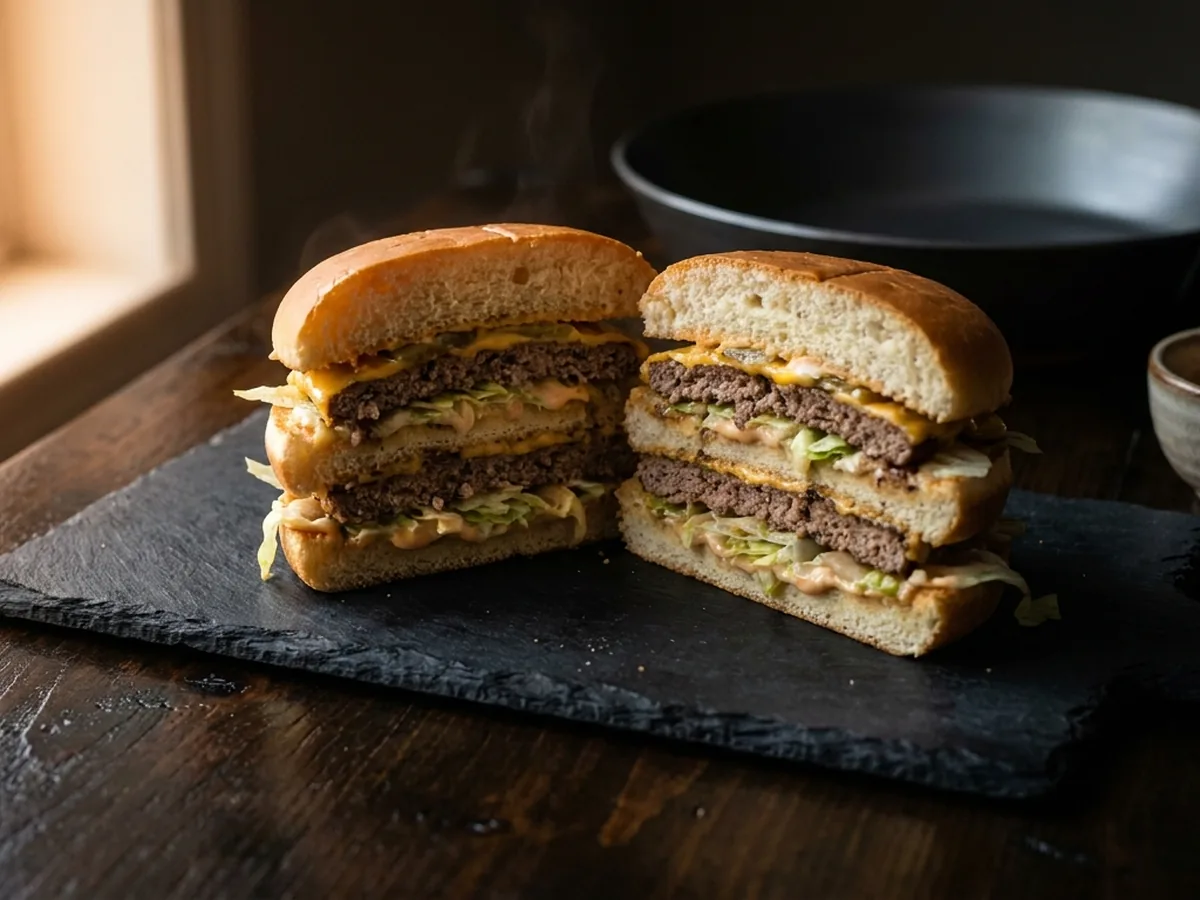
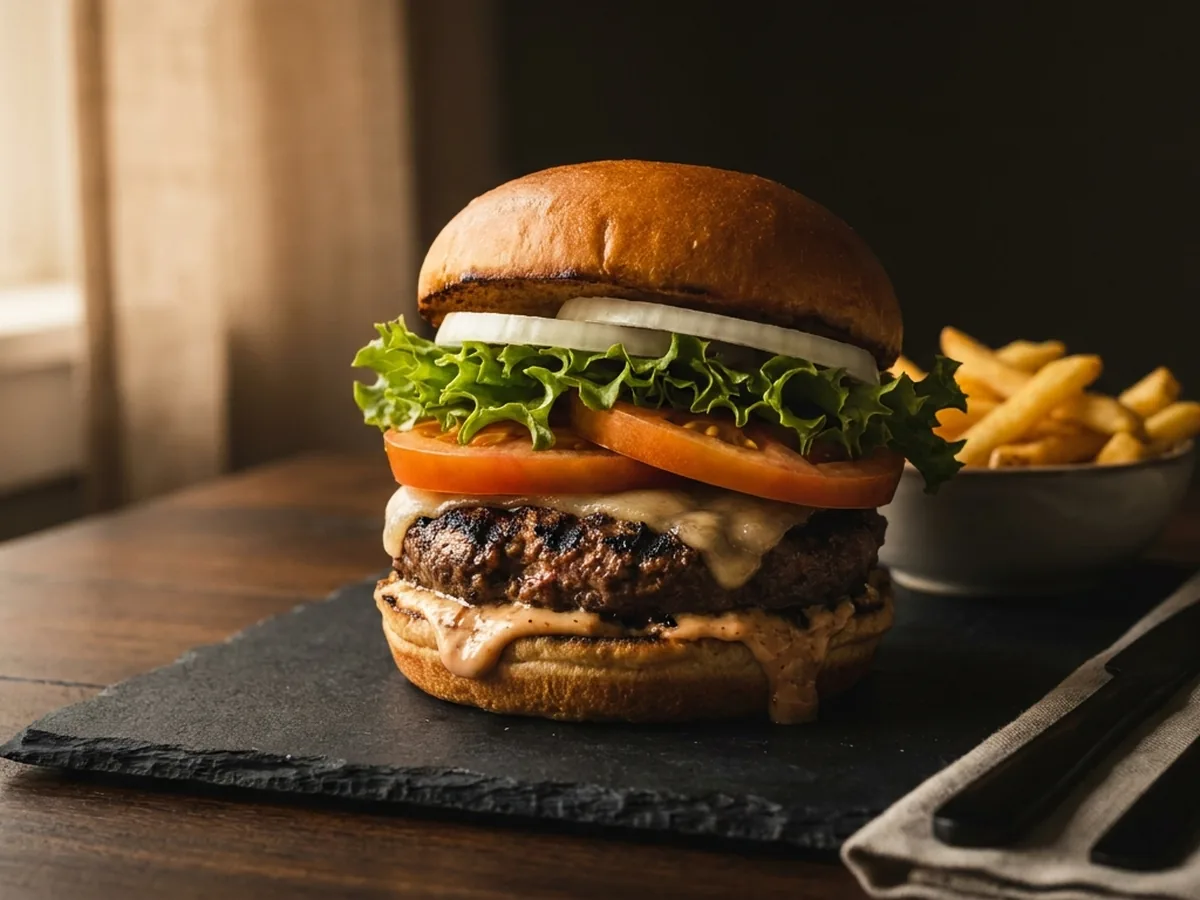
AI-generated illustration created for food.fast. It is not photographic evidence of a prepared batch.
The Big Mac is an architecture problem disguised as a burger. Almost everything that makes a home version disappointing is structural rather than culinary: the patties are too thick, the sauce is in the wrong places, the lettuce is the wrong cut, and the middle bun has been skipped because it seemed like a fussy detail.
It is not a fussy detail. That third piece of bun is what stops the whole sandwich from being a wet tower. It absorbs sauce from above and below, it keeps the shredded lettuce from touching the hot patty and wilting into slime, and it is the reason a Big Mac survives being carried in a box for twenty minutes when a double cheeseburger does not.
The rest is thin patties, hard heat and restraint with the sauce. Make the sauce the day before - it needs the rest, and the reasons are on its own page - and this is a twenty-minute job.
The method gives quantities, timings and observable cues rather than asking you to guess. The 5 cases in If it goes wrong explain likely causes and corrective action; 2 ingredient notes explain choices that materially affect the result.
See the recipe verification standard · See how the cost is calculated
A Big Mac patty is about 1.6 ounces - 45 grams - before cooking, which is roughly a third of what most people mean by "a burger patty". At that weight a 100 mm patty is barely thicker than a pound coin.
The reason is surface area. A thin patty pressed onto a very hot surface is almost all crust, and crust is where the flavour lives. Make the patty twice as thick and you have twice the beef and the same amount of browning, which reads as blander even though there is more of it. You also lose the specific thing that makes this sandwich work: two thin patties with a bun between them, rather than one thick one.
Weigh them. It takes thirty seconds and it is the difference between a Big Mac and a double cheeseburger with lettuce on it.
The minced onion in a Big Mac is dried, and it is rehydrated in cold water before it goes on. This sounds like an industrial shortcut and it is, but it is also a different ingredient with a different flavour, and substituting fresh onion produces something that tastes correct and wrong at the same time - which is the most frustrating kind of failure, because you cannot name what is off.
Dried minced onion is in every supermarket, usually near the dried herbs, and costs very little. Two tablespoons in four of cold water for ten minutes gives you exactly the soft, sweet, slightly muted onion the sandwich wants.
If you genuinely cannot get it: grate a white onion on the coarse side of a box grater, rinse it under cold water in a sieve for thirty seconds and pat it dry. That knocks back the raw sharpness and gets you most of the way.
Shredded iceberg lettuce, cut to about 3 mm ribbons. Not leaves, not baby gem, not "a nice crunchy lettuce". Iceberg holds water inside a structure that stays crisp against a hot patty for the few minutes that matter, and shredding it means it packs into an even layer that the sauce can hold in place.
A leaf of lettuce, however good the lettuce, sits as a single slippery plane and is the reason home burgers slide apart.
Shred it, then keep it in a bowl in the fridge until the moment of assembly. Warm lettuce is limp lettuce.
Buy six buns for four burgers. Use the bottom halves of two of them as the middle layers and keep the tops for something else, or toast them separately so the unused tops are not wasted.
A single-wrapped processed slice contains emulsifying salts that keep it liquid and glossy when melted. Real cheddar breaks into oil and protein under the same heat and slides off the patty. This is one of the few places on this site where the industrial product is genuinely the right answer.
Everything below the beef can be prepared before the pan goes on. Once the patties start cooking you have about four minutes and no time to shred a lettuce.
Two tablespoons of dried minced onion into four tablespoons of cold water. Leave it for ten minutes, then drain off anything that has not been absorbed. It should be soft and damp, not swimming.
About 10 minQuarter an iceberg, cut out the core, and slice across into 3 mm ribbons. Into a bowl, into the fridge. This is the difference between crisp and limp on the plate.
About 5 minDry pan, medium heat, cut side down, thirty to forty seconds until the surface is pale gold and dry to the touch. No butter and no oil - you are drying the surface so it resists the sauce, not browning it for flavour.
Roll each one loosely between your palms until it just holds together. A tightly packed ball gives a dense, bouncy patty; a loose one falls apart into the lacy edges you actually want.
About 4 minFive full minutes on high. A drop of water should skitter across the surface and vanish, not sit and boil. If the pan is not hot enough the beef steams and goes grey, and no amount of time afterwards recovers it.
About 5 minTwo or three balls at a time, well spaced. Press each one hard and flat with the spatula as soon as it hits the pan - aim for roughly 10 cm across and very thin. Then leave it entirely for 90 seconds while the crust forms.
Season the upward face while it cooks. When the edges have gone brown and lacy and the top has lost its raw colour, scrape under it firmly - you want the crust to come with it - and flip. Thirty seconds more, then cheese onto four of the eight patties.
A level tablespoon of sauce spread to the edges, then a scattering of onion, then a small handful of lettuce, then the patty with the melted cheese on it. The sauce is the glue that holds the lettuce down.
About 1 minToasted middle bun on top of the cheese. Then sauce, onion, lettuce, four pickle slices, and the second patty - this one bare.
Press the whole thing down gently with your palm and let it stand for sixty seconds. The steam softens the bun, the sauce settles, and the sandwich compresses into something you can pick up. Cutting into it immediately gives a much messier result.
About 1 minThe ingredient list scales cleanly. The cooking does not, and it is worth being clear about why before you double it for a crowd.
Patties do not scale with time, they scale with pan space. Sixteen patties take the same ninety seconds a side as four; they simply will not fit. Cook in batches of three or four, keep the finished ones stacked on a warm plate under foil, and accept that the first ones will be five minutes older than the last. Crowding the pan drops the surface temperature and you get grey steamed beef, which is a worse outcome than a slightly cooled patty.
Assembly is the bottleneck, not cooking. For more than four burgers, lay out all the bottom buns first, sauce them all, onion them all, and so on - a production line rather than one sandwich at a time. This is exactly how the restaurant does it and for exactly this reason.
Double the sauce quantity but not the pickle. Pickle is the one component people reliably overdo at scale.
Six buns for four burgers leaves two orphaned tops. They are enriched, sesame- topped bread and they are good: split and toast them with the remaining sauce as a snack while you cook, blitz them into breadcrumbs for the Zinger-style coating, or freeze them and use them next time as middle layers, which is what they are.
| Component | Amount | Cost |
|---|---|---|
| Beef mince, 20% fat | 360 g | £2.16 |
| Sesame buns | 6 | £0.90 |
| Processed cheese slices | 4 | £0.44 |
| Iceberg lettuce | ⅓ head | £0.29 |
| Pickles, dried onion, sauce | - | £0.61 |
| Four burgers at home | £4.40 | |
| Four Big Macs, UK counter price | £17.96 |
| Batch | Patties | Weight each | Rounds in a 28 cm pan | Hands-on time |
|---|---|---|---|---|
| 1X - 4 burgers | 8 | 45 g | 3 | about 10 min |
| 2X - 8 burgers | 16 | 45 g | 5 | about 18 min |
| 4X - 16 burgers | 32 | 45 g | 9 | about 32 min |
| 8X - 32 burgers | 64 | 45 g | 17 | use two pans |
One 113 g patty instead of two 45 g ones, no middle bun, no lettuce, and mustard and ketchup in place of the sauce. A completely different sandwich built from the same shopping list.
Two 75 g patties and a larger bun. The sauce quantity goes up by half, not double - the extra beef needs less help than you think.
If you genuinely cannot face buying six buns for four burgers, use a single patty and accept it is a cheeseburger with Big Mac sauce, which is a fine thing to eat and not this.
Each entry names a likely cause as well as a correction, so the advice remains useful when equipment, ingredients or batch size differ.
The recipes that go with this one, or that use what you have just made.
Eight minutes, one bowl, no cooking. The sweet pickle relish base that every 'secret sauce' recipe gets wrong, and th…
Thin-cut, sugar-dipped, twice fried. Genuinely close on texture, and the page says plainly which part cannot be matched.
A crust taken further than feels comfortable, on a soft sweet roll, with ShackSauce underneath. Twelve minutes.
A flame-grilled quarter-pound patty, a serious quantity of mayonnaise, and more raw vegetable than any other chain bu…