Krispy Kreme
Krispy Kreme Original Glazed Copycat Recipe
A very soft enriched dough, a short proof, forty-five seconds a side, and a thin glaze applied immediately. The heat …
 food.fast
Takeaway taste, kitchen prices
A Filled Doughnut Is a Custard Recipe Wearing a Doughnut Costume
A custard that holds its shape inside a doughnut instead of running out of it.
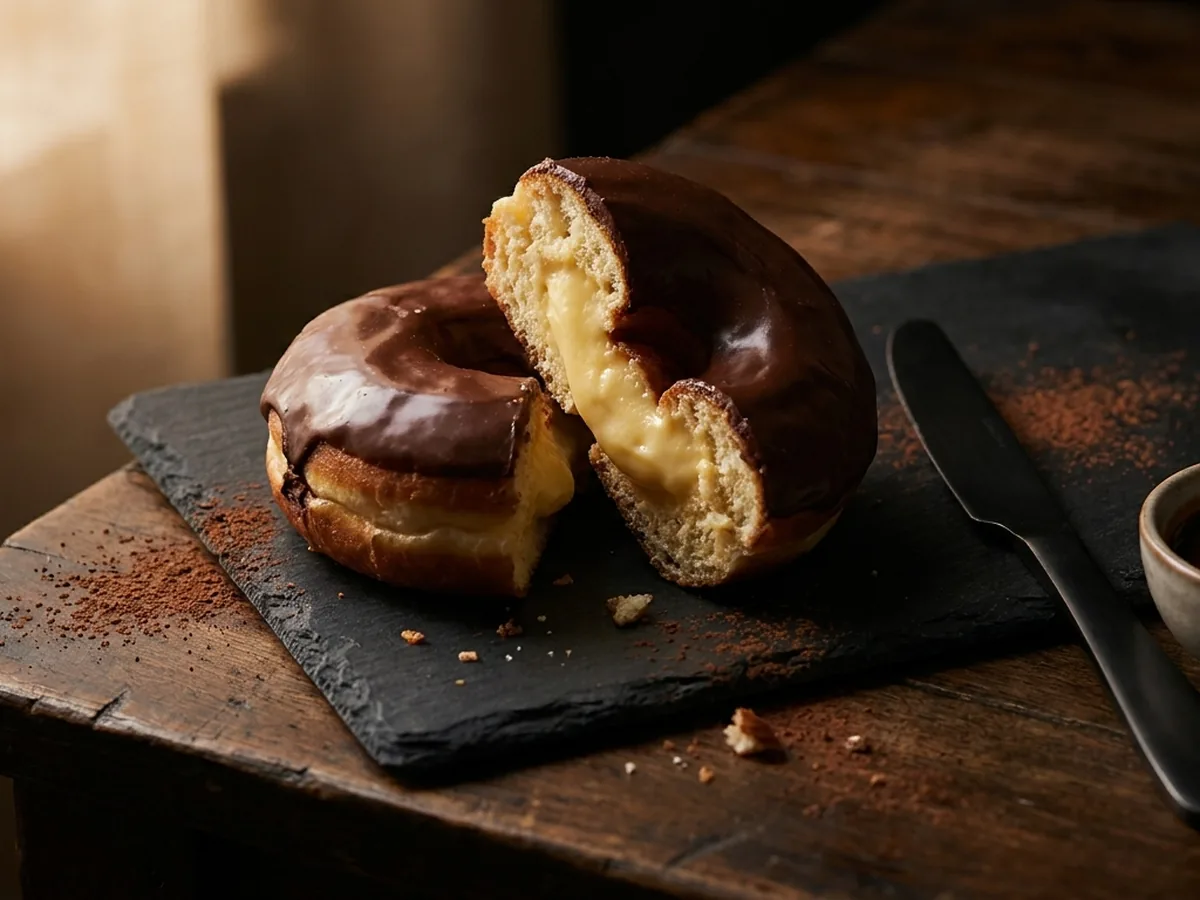
AI-generated illustration created for food.fast. It is not photographic evidence of a prepared batch.
The dough is the same as the Original Glazed and there is no point repeating it - the technique, the proving and the frying are identical, with one change: do not cut a hole.
What makes this a different recipe is the filling. Crème pâtissière - pastry cream - is a custard thickened with cornflour as well as egg, and the cornflour is why it can hold its shape inside a doughnut where a crème anglaise would run straight out.
It is also the component people are most nervous about and it is genuinely straightforward, provided you accept one thing: you have to boil it. A pastry cream that has not been brought to a proper boil for a full minute will be thin and will taste of raw flour.
The method gives quantities, timings and observable cues rather than asking you to guess. The 6 cases in If it goes wrong explain likely causes and corrective action.
See the recipe verification standard · See how the cost is calculated
This is the thing that trips people up, because everything they know about custard says do not boil it.
For a crème anglaise - a pouring custard thickened with egg yolk alone - that is correct. Egg proteins set at around 82 °C and curdle above about 85, so a pouring custard has to be held below.
Crème pâtissière contains cornflour, and cornflour changes everything. Starch granules only fully gelatinise and reach their thickening power at a rolling boil. And the starch physically protects the egg proteins from curdling - it gets between them and stops them linking up.
So a pastry cream must reach a full rolling boil and be held there, whisking hard, for one full minute. Under-boiled, it is thin and tastes of raw flour. That minute is the recipe.
It will look terrifyingly thick at that point. It loosens as it cools and then sets again, and it will need whisking smooth before it goes into a piping bag.
Three rules.
Fill from the side, not the top. A hole in the side is hidden once the glaze goes on and does not weaken the top, which has to support the chocolate.
Make a channel first. Push a chopstick or the handle of a wooden spoon into the side, most of the way through, and waggle it to create a cavity. Filling without a channel just compresses the crumb and the custard sits in one lump near the entry point.
Fill until you feel resistance and then stop. Roughly 30 g per doughnut. Too much and the doughnut splits along its equator, which cannot be hidden.
Cool them completely first. Piping cold custard into a warm doughnut melts it and it runs out.
A piping bag with a 6 mm plain nozzle, or a Bismarck nozzle if you have one - a long thin tube designed for exactly this. A freezer bag with the corner snipped off works.
Not boiling. If using a vanilla pod, split it in and let it infuse off the heat for ten minutes.
About 4 minPale and thick. No lumps of cornflour - they will not disappear later.
About 2 minA third of the milk first, poured in a thin stream while whisking, then the rest. Pouring it all in at once scrambles the eggs.
About 2 minMedium heat, whisking constantly and scraping the corners. It will thicken suddenly and then start to bubble. Count sixty seconds from the first bubble.
Whisk until smooth, press cling film directly onto the surface so no skin forms, and refrigerate for at least two hours.
About 2 hr8 cm rounds, proved thirty minutes on oiled parchment squares.
About 40 minSlightly longer than a ring doughnut, because there is more dough in the middle. Onto a rack and cool completely.
About 16 minIt will have set firm. Whisk it hard for thirty seconds until it is smooth and pipeable again.
About 3 minChopstick into the side, waggled. Nozzle in, squeeze until you feel resistance, stop.
About 8 minIcing sugar, cocoa, hot milk, melted butter and vanilla, whisked smooth. It should ribbon off a spoon. Dip the top of each doughnut, lift, let it drip, and set on a rack.
About 6 minA batch of crème pâtissière is the base of a surprising amount:
It keeps three days in the fridge with cling film pressed onto the surface, and it does not freeze - the starch structure breaks down and it goes watery on thawing.
To flavour it: infuse the milk. Coffee beans, a cinnamon stick, citrus zest, a bay leaf. Ten minutes off the heat, then strain. Chocolate is the exception - 100 g of chopped dark chocolate whisked in at the end, off the heat.
Good raspberry or strawberry jam, loosened with a teaspoon of water, in place of the custard. Far easier and genuinely good.
100 g of chopped dark chocolate whisked into the finished custard off the heat.
Infuse the milk with 3 tbsp of coffee beans for ten minutes and strain. Excellent with the chocolate glaze.
Each entry names a likely cause as well as a correction, so the advice remains useful when equipment, ingredients or batch size differ.
The recipes that go with this one, or that use what you have just made.
A very soft enriched dough, a short proof, forty-five seconds a side, and a thin glaze applied immediately. The heat …
Hot-brewed at double strength, chilled fast, and sweetened with syrup rather than granules. Five minutes plus chilling.
An enriched dough, a filling that is a third cinnamon by volume, and a cream cheese frosting with a much higher chees…
Thick, soft and deliberately under-baked so the middle stays molten. Twenty minutes, and the timing is the entire recipe.