Krispy Kreme
Krispy Kreme Original Glazed Copycat Recipe
A very soft enriched dough, a short proof, forty-five seconds a side, and a thin glaze applied immediately. The heat …
 food.fast
Takeaway taste, kitchen prices
Cinnamon Rolls: Crowd the Tin and Use More Cinnamon Than Feels Sensible
Rolls that stay soft at the sides and a frosting that tastes tangy rather than merely sweet.
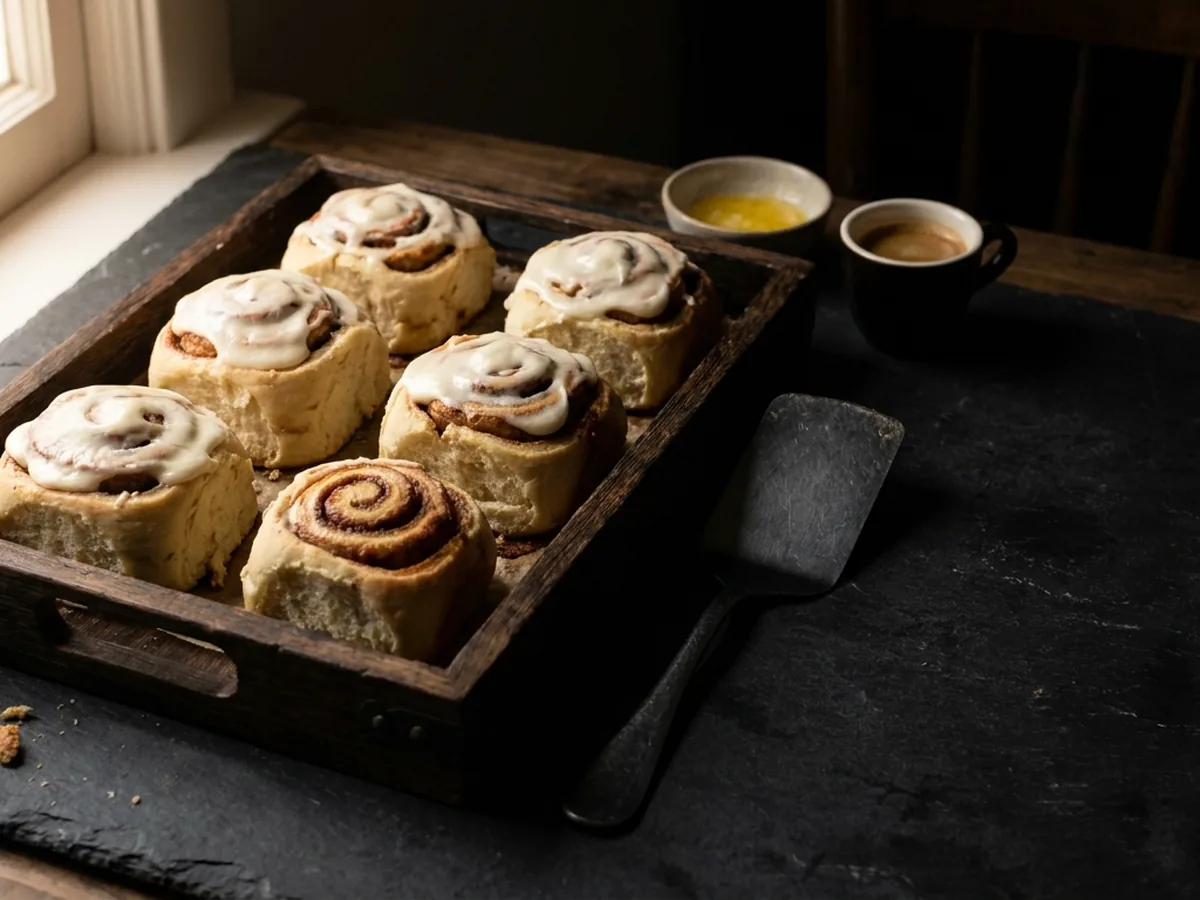
AI-generated illustration created for food.fast. It is not photographic evidence of a prepared batch.
Cinnabon is built on two specifics and one technique, and getting all three right is the difference between a cinnamon roll and the cinnamon roll.
The first specific is the cinnamon. The company uses a high-oil Korintje variety it markets under its own name - noticeably sweeter, rounder and less sharp than the cassia in a supermarket jar - and it uses a lot of it. The filling here is roughly a third cinnamon by volume against the sugar, which looks alarming written down.
The second is the frosting, which has far more cream cheese in it than a home recipe usually calls for. That is why it tastes tangy and slightly savoury under the sweetness instead of being a lump of icing.
The technique is crowding. The rolls are baked with their sides touching so they cannot brown at the edges, which keeps them soft and pale and makes them pull apart.
The method gives quantities, timings and observable cues rather than asking you to guess. The 5 cases in If it goes wrong explain likely causes and corrective action.
See the recipe verification standard · See how the cost is calculated
Most supermarket cinnamon is cassia - Cinnamomum cassia, from China, Vietnam or Indonesia. It is strong, sharp and slightly astringent, and it is what most people think cinnamon tastes like.
Korintje is a specific Indonesian cassia with a higher volatile oil content - around 2.5 to 4 per cent - which makes it sweeter and rounder. It is what Cinnabon uses.
Saigon cinnamon (Cinnamomum loureiroi) is higher still in oil, and is the most intensely cinnamon-tasting of the lot. It is an excellent substitute and widely available online.
Ceylon cinnamon - "true" cinnamon - is milder, more floral and considerably more expensive. It is a lovely spice and it is the wrong one here; it disappears under the sugar.
The practical advice: buy Saigon or Korintje online, use it within a year, and notice the difference. If all you have is supermarket cassia, use it and reduce the quantity by about a fifth, because it is sharper.
Nine rolls in a 23 cm square tin is a tight fit, and that is the point.
Where two rolls touch, there is no exposed surface, so no browning happens. Each roll shields its neighbours, and the ones in the middle are effectively steaming inside a wall of dough. The result is a roll that is golden on top and pale, soft and slightly under-set at the sides, which is exactly the texture people mean when they describe these as gooey.
Space them out on a tray and every roll browns on all sides. They become individual sweet buns - perfectly nice, entirely different.
The rolls in the middle will always be softer than the ones at the edges. That is the hierarchy and everybody knows about it.
A typical home cream cheese frosting is heavy on butter and icing sugar with a little cream cheese for flavour. This one inverts that: more cream cheese than butter, and less icing sugar than you would expect.
The result is tangy, slightly savoury and much less cloying, which is what allows you to put a genuinely thick layer on without it becoming unbearable.
Use full-fat block cream cheese, not the spreadable tub kind, which has added water and gum and makes a runny frosting.
It goes on while the rolls are warm, not hot. Warm means about half of it melts into the crevices and half stays on top as a distinct layer, which is the correct outcome. Hot rolls melt all of it into a glaze; cold rolls take it as a stiff cap.
About ten minutes out of the oven is the moment.
Flour, milk, sugar, eggs and yeast first, rested ten minutes. Then the softened butter in pieces and the salt, kneaded until smooth and elastic. It will look broken for several minutes.
About 22 minCovered, somewhere warm. Enriched doughs rise more slowly than lean ones because the fat and sugar both slow the yeast down, so do not be alarmed if it is still climbing at the hour mark. It should double and feel pillowy.
About 1 hr 30 minOn a lightly floured surface, with the long edge towards you. Even thickness matters more than exact dimensions.
About 5 minBeat the brown sugar, cinnamon, soft butter and salt to a paste, then spread it over the dough leaving a 2 cm clear strip along the far long edge - that strip is what seals the log.
Tight, keeping the tension even along the length. A loose roll gives a roll with a hole in the middle.
About 3 minSlide a length of floss under the log, cross the ends over the top and pull. It cuts cleanly without squashing the spiral, which a knife cannot do.
About 4 minNine in a 23 cm square tin, three by three. They should swell into each other and fill the tin completely.
About 1 hrGolden on top, pale where they touch. If the tops are browning fast at fifteen minutes, lay a sheet of foil over them.
About 26 minCream cheese and butter beaten until smooth, then the icing sugar, vanilla, lemon juice and salt. Beat for two minutes until light.
About 5 minWarm, not hot. Spread it thickly over the whole tray. About half will melt into the crevices and half will stay on top, which is correct.
About 3 minShape the rolls, put them in the tin, cover tightly and refrigerate overnight instead of proving at room temperature.
In the morning, take them out and let them come back to room temperature and finish proving - about ninety minutes - then bake as written.
The cold overnight rest also improves the flavour, for the same reasons set out on the Domino's dough page: slow fermentation develops compounds a fast rise never produces.
This is the version worth doing. Forty minutes of work the night before, and ninety minutes of waiting plus twenty-five of baking in the morning.
| Component | Amount | Cost |
|---|---|---|
| Bread flour | 500 g | £0.53 |
| Butter | 260 g total | £1.30 |
| Cream cheese | 180 g | £0.72 |
| Sugars, eggs, milk, cinnamon | - | £0.65 |
| Nine rolls at home | £3.20 | |
| Nine Classic Rolls, UK price | £40.41 |
Pour 150 g of caramel sauce into the tin before the rolls go in, and scatter 100 g of toasted pecans over the filling. Turn the tray out upside down after baking.
Shape, refrigerate overnight, then ninety minutes at room temperature before baking. Better flavour and better timing.
Cut sixteen smaller rolls and bake for 18 minutes in the same tin. Better ratio of frosting to dough.
Each entry names a likely cause as well as a correction, so the advice remains useful when equipment, ingredients or batch size differ.
The recipes that go with this one, or that use what you have just made.
A very soft enriched dough, a short proof, forty-five seconds a side, and a thin glaze applied immediately. The heat …
Thick, soft and deliberately under-baked so the middle stays molten. Twenty minutes, and the timing is the entire recipe.
A pumpkin spice sauce made in fifteen minutes that keeps two weeks, and the drink built from it in ninety seconds.
An ordinary bread dough put through an alkaline bath, buttered twice, and salted with coarse crystals. Thirty minutes…