Pizza Hut
Pizza Hut Pan Pizza Copycat Recipe
Three tablespoons of oil in the tin, a dough that proves where it bakes, and a base that fries from underneath. The o…
 food.fast
Takeaway taste, kitchen prices
Cold-Fermented Pizza Dough: 48 Hours of Flavour You Cannot Buy
Dough that tastes of bread rather than of flour, which is entirely a matter of time.
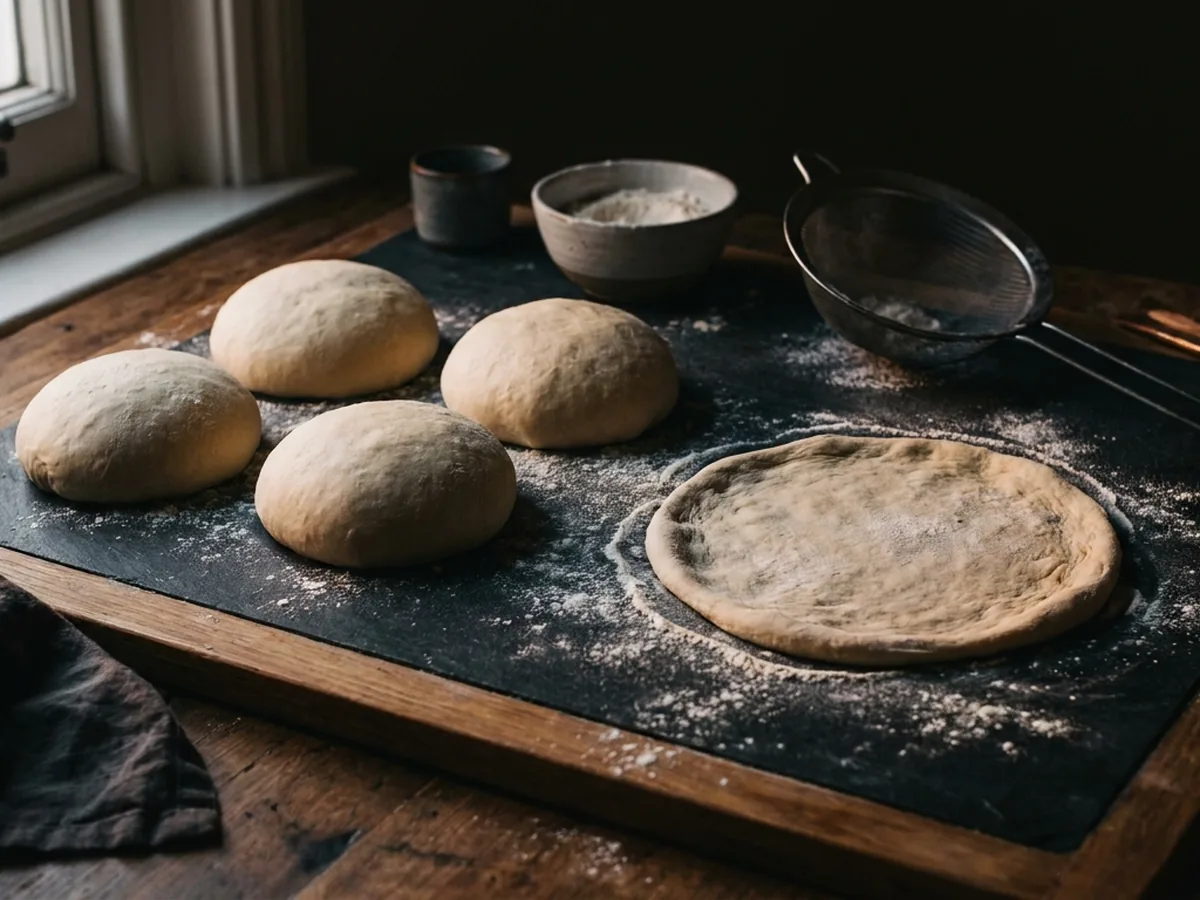
AI-generated illustration created for food.fast. It is not photographic evidence of a prepared batch.
The single biggest difference between home pizza and delivery pizza is not the oven and not the cheese. It is that the dough has been fermenting in a cold room for two days and yours was made an hour ago.
Same-day dough tastes of flour and yeast. It is perfectly edible and it is the reason people conclude their oven is the problem. Two-day dough tastes of bread - there is a depth and a faint sweetness that simply is not available on a shorter timescale, because the compounds responsible take that long to form.
The work is fifteen minutes. Everything else is waiting, in a fridge, on a day when you are not making pizza.
The method gives quantities, timings and observable cues rather than asking you to guess. The 5 cases in If it goes wrong explain likely causes and corrective action; 1 ingredient note explains choices that materially affect the result.
See the recipe verification standard · See how the cost is calculated
Yeast at 4 °C is not dormant - it is slow. Fermentation continues at perhaps a twentieth of the room-temperature rate, which changes the balance of what gets produced.
At room temperature, yeast races through the available sugars producing carbon dioxide and ethanol quickly. The dough rises fast and the flavour compounds barely have time to form.
At fridge temperature, three slower processes catch up:
The practical result at 48 hours: better browning, better flavour, and a dough that stretches rather than fights back.
Past 72 hours the gluten starts to degrade faster than it is being built and the dough goes slack and tears. Two to three days is the window.
Domino's presses its dough in a machine rather than hand-stretching it, which gives the very even thickness a delivery pizza has.
At home, the equivalent is pressing with your fingertips on a floured surface, working from the centre outward and leaving the outer centimetre alone. That untouched rim keeps its gas bubbles and puffs in the oven into a crust.
Never use a rolling pin. A rolling pin crushes every gas bubble in the dough, including in the rim, and gives a flat, dense, cracker-like base with no crust at all. This is the most common mistake in home pizza and it is completely avoidable.
If the dough springs back, stop, cover it, wait ten minutes and come back. Gluten relaxes on its own and fighting it tears the structure.
A same-day dough uses three or four times this much yeast and warm water, because it needs to rise in two hours. This one has forty-eight. Too much yeast over that period exhausts the available sugars, and the dough over-ferments, goes slack and smells of beer. Cool water and a small amount of yeast is what makes a long ferment controllable.
Everything except the salt mixed to a shaggy mass, rested ten minutes, then the salt added and kneaded eight minutes until smooth and elastic.
About 20 minAbout 250 g each. Shape each by dragging it across the worktop under a cupped hand until the surface is smooth and taut. That surface tension is what makes the ball hold its shape for two days.
About 5 minEach ball in its own lightly oiled container with a lid, or all four in a box with space between them - they will roughly double. Anywhere from 24 to 72 hours works; 48 is the sweet spot.
About 2 daysCold dough will not stretch. It needs to come to room temperature all the way through, which takes longer than you expect.
About 2 hr250 °C or higher with the stone or tray in place. Forty-five minutes is not an exaggeration - a stone needs that long to reach the oven's temperature all the way through.
About 45 minOn a well-floured surface, fingertips, from the middle outward. Do not touch the rim. If it springs back, rest it ten minutes.
Work fast - dough sitting on a floured peel starts to stick within a couple of minutes. Slide it on with one confident movement.
About 10 minMake a double batch, cold-ferment for 24 hours, then freeze what you do not need. The balls freeze extremely well at that point and keep three months.
To use: into the fridge the night before, then two hours at room temperature. The thawing time in the fridge counts as more cold fermentation, so a frozen ball that has thawed overnight has effectively had its full 48 hours.
This turns pizza from a two-day project into a twenty-minute one, permanently. Frozen dough balls in a drawer is the single most useful thing in this kitchen's freezer.
| Time | Flavour | Handling | Browning |
|---|---|---|---|
| 2 hours, room temp | Flour and yeast | Springy, fights back | Pale |
| 24 hours | Faintly bready | Easier | Better |
| 48 hours | Bready, slightly sweet | Stretches easily | Good |
| 72 hours | Bready with a tang | Very extensible, near the limit | Very good |
| 96 hours | Sour, beery | Slack, tears | Good but the dough has gone |
Raise the yeast to 8 g and use warm water. Two hours at room temperature. It will work and it will taste of flour.
Reduce the hydration to 55% - 330 ml of water for 600 g of flour - and press it thinner. Bake for 7 minutes.
Mix 200 g of the flour with 200 ml of the water and a pinch of the yeast, and leave it 12 hours at room temperature before making the final dough. More flavour again, and one more step.
Each entry names a likely cause as well as a correction, so the advice remains useful when equipment, ingredients or batch size differ.
The recipes that go with this one, or that use what you have just made.
Three tablespoons of oil in the tin, a dough that proves where it bakes, and a base that fries from underneath. The o…
The most requested copycat dip in Britain. Four minutes, six ingredients, and two decisions that most versions get wrong.
Butter with the milk solids skimmed off, garlic powder and salt. Six minutes, and the skimming is what keeps it clear…
Walnut-sized, baked hot and fast so they stay pale and pillowy, with a soft garlic butter that melts into them. About…