McDonald's
McDonald's Sausage and Egg McMuffin Copycat Recipe
A sage-heavy sausage patty, an egg cooked in a ring, and a properly toasted muffin. Fifteen minutes, and better than …
 food.fast
Takeaway taste, kitchen prices
Southern Biscuits: Cold Fat, Three Folds, and Never Twist the Cutter
Biscuits that pull apart in layers, which is three folds and a straight cut.
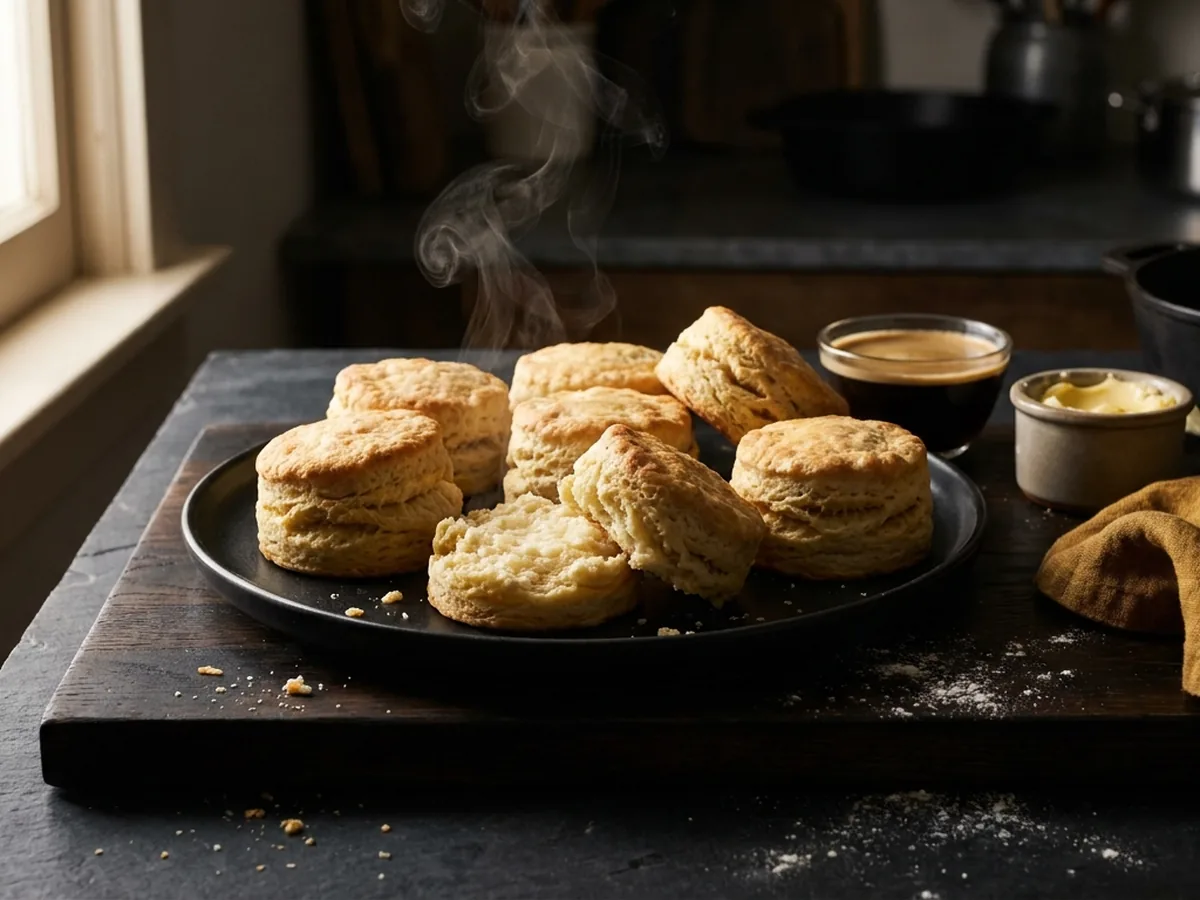
AI-generated illustration created for food.fast. It is not photographic evidence of a prepared batch.
A Southern buttermilk biscuit is a genuinely different object from a British scone, despite looking similar. More fat, no sugar to speak of, a much wetter dough, and folded rather than kneaded. The result is savoury, flaky and made to be split and filled.
Hardee's makes them in the restaurant every morning, which is unusual for a chain and is the reason the breakfast menu has the following it does.
Three rules decide whether yours work: the fat must be cold, the dough must be folded rather than worked, and the cutter must go straight down without twisting. Everything else is forgiving.
The method gives quantities, timings and observable cues rather than asking you to guess. The 5 cases in If it goes wrong explain likely causes and corrective action; 1 ingredient note explains choices that materially affect the result.
See the recipe verification standard · See how the cost is calculated
The layers in a biscuit come from pieces of solid fat suspended in the dough. In the oven, the water in that butter turns to steam and forces the dough apart where each piece sat. Distinct pieces of cold butter produce distinct layers.
Warm butter smears into the flour and coats it instead, waterproofing the starch and giving a dense, short, crumbly biscuit - like a shortbread. Perfectly pleasant and not what you are after.
The trick is to freeze the butter and grate it. Thirty minutes in the freezer, then the coarse side of a box grater straight into the flour. You get evenly sized, evenly distributed shards of cold butter in about forty seconds, and with far less handling than rubbing in by hand.
Work fast after that. If the kitchen is warm, put the bowl back in the fridge for ten minutes before you roll.
Pat the dough into a rectangle. Fold it in three like a letter. Turn it ninety degrees, pat it out, fold again. Do that three times in total.
Each fold roughly triples the number of fat layers. Three folds takes you from one layer to twenty-seven, and that is where the pull-apart texture comes from.
It is the same principle as laminating puff pastry, done quickly and crudely. You are not trying for hundreds of paper-thin layers - twenty-odd chunky ones is exactly right for a biscuit.
More than three folds starts to develop gluten and the biscuit turns tough. Fewer than two and there are not enough layers to notice.
Between folds, if the butter starts to look smeared rather than distinct, put the whole thing in the fridge for ten minutes.
Press the cutter straight down, through the dough, onto the board. Lift it straight up. Do not rotate it at any point.
Twisting drags the cut edge sideways and seals the layers together at the rim. A sealed rim physically cannot rise, so the biscuit lifts in the middle and stays squat at the edges - and it will not pull apart.
You can see it in the oven. Straight-cut biscuits climb evenly with a visible seam around the side; twisted ones dome.
Two related points:
Buttermilk is acidic. Bicarbonate of soda reacts with that acid immediately for an initial lift and, importantly, raises the pH so the biscuits brown properly. Baking powder contains its own acid and provides a second, slower lift in the oven. Using only one gives you either a pale biscuit or a flat one.
Coarse side of a box grater, straight into the bowl of flour, baking powder, bicarb, salt and sugar. Toss with a fork - do not rub with your hands, which warms it.
About 33 minAll at once, stirred until it just holds. It will be shaggy and look too wet. That is right - a dry biscuit dough gives a dry biscuit.
About 2 minPat to a rectangle about 2 cm thick, fold in three, turn ninety degrees, repeat twice more. Pat, do not roll hard.
Thick - 2.5 cm, not 1.5. Cutter dipped in flour, pressed straight down, lifted straight up. No twisting.
About 4 minTouching, so they support each other upward and stay soft at the sides. The fridge rest re-firms the butter.
About 15 minHot and fast. They should be deep golden on top and pale where they touch.
About 15 minGenerously. It is what gives them the gloss and the smell.
About 1 minThe two classics, and both are on this site or adjacent to it:
Sausage gravy. A white gravy made from the fat of browned breakfast sausage - the same seasoning as the McMuffin sausage - with flour, milk and a great deal of black pepper. Poured over a split biscuit, it is one of the great cheap breakfasts.
A breakfast sandwich. Split, with a sausage patty, a fried egg and a slice of cheese. This is what Hardee's actually sells and it is better than any muffin version.
Beyond that: butter and honey, butter and jam, or fried chicken and hot honey, which is a more recent idea and a very good one.
100 g grated mature cheddar and 3 tbsp chopped chives tossed in with the butter.
Add 50 ml more buttermilk and spoon the dough onto the tray in rough mounds. No folding, no cutting, five minutes faster, and no layers.
Whole milk with a tablespoon of lemon juice per cup, left ten minutes. Keep the bicarbonate of soda - it needs the acid.
Each entry names a likely cause as well as a correction, so the advice remains useful when equipment, ingredients or batch size differ.
The recipes that go with this one, or that use what you have just made.
A sage-heavy sausage patty, an egg cooked in a ring, and a properly toasted muffin. Fifteen minutes, and better than …
A soft honey-and-molasses wheat loaf coloured with cocoa, rolled in oats. Two and a half hours, mostly rising.
Deliberately softer and smoother than a British mash, seasoned to be eaten with gravy rather than alone. Twenty-five …
Walnut-sized, baked hot and fast so they stay pale and pillowy, with a soft garlic butter that melts into them. About…