McDonald's
McDonald's Big Mac Copycat Recipe
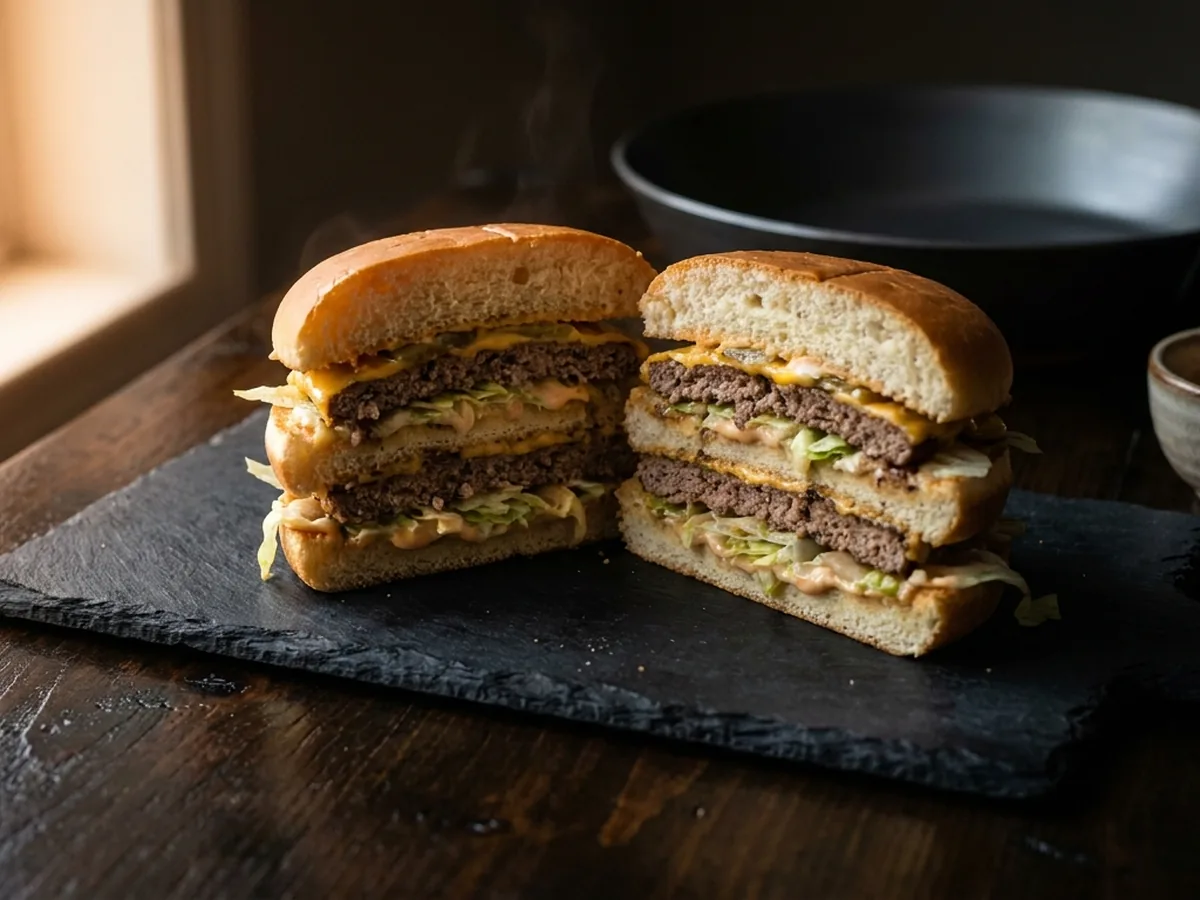
Two thin patties, a three-piece bun and the assembly order that stops the whole thing sliding apart on the second bit…
 food.fast
Takeaway taste, kitchen prices
Eighty-Twenty Is Not a Suggestion
Fat is both the moisture and the browning in a burger, and lean mince cannot be rescued by technique. Here is what each ratio does, which cut to use, and why a coarse grind matters.
Three jobs, and no substitute does any of them.
Moisture. Beef muscle is around 70 per cent water, and cooking drives a lot of it off. Rendered fat replaces some of that perceived moisture and coats the palate, which is most of what "juicy" means.
Browning. Fat conducts heat efficiently into the surface and the browning reactions happen in and around it. A lean patty browns visibly less at the same temperature.
Flavour. A large share of what beef tastes of is dissolved in its fat. Lean mince from the same animal tastes measurably less beefy.
The practical ratios:
Below 15 per cent there is no technique that saves it, which is worth knowing before you buy.
| Cut | Fat | What it brings |
|---|---|---|
| Chuck | 18-22% | The default. Beefy, well balanced, cheap |
| Brisket | 20-25% | Deep, almost smoky flavour; best in a blend |
| Short rib | 25-30% | Rich and fatty; 25% of a blend, no more |
| Sirloin | 10-15% | Clean and mild; needs fat added |
| Rump | 12-15% | Firm and lean; workable in a blend |
| "Beef mince" | Unknown | Usually lean and finely ground - avoid |
The house blend most steakhouses use is roughly 60 per cent chuck, 25 per cent brisket and 15 per cent short rib. It is genuinely better than chuck alone and any butcher will grind it if asked.
For a chain copy, chuck alone at 20 per cent is correct. Chains do not use brisket blends and the extra richness makes a Big Mac copy taste wrong in an interesting way rather than right.
What to avoid is supermarket "beef mince" with no cut named. It is usually trimmings, ground fine, at an unstated fat level, and it makes a dense patty.
A grinder plate with larger holes produces larger pieces of meat, and larger pieces pack together more loosely with more air between them.
Coarse grind (6 to 8 mm plate): a loose, open patty that holds its juices in the gaps and has a pleasantly irregular texture. This is what a good burger wants.
Fine grind (3 to 4 mm plate): the pieces interlock tightly, the patty is dense, and it reads as slightly springy. This is what most supermarket mince is, because fine grinding makes cheaper trimmings look more uniform.
Ask a butcher for a single coarse grind. Most default to grinding twice, which is a texture decision made for supermarket display rather than for a burger.
Temperature matters as much as plate size. If the meat warms above about 5 °C during grinding, the fat smears rather than cutting cleanly, and smeared fat coats the protein and gives a pasty texture. Butchers chill meat and grinder parts for this reason.
If you grind at home, freeze the diced meat for twenty minutes and chill the grinder parts. It is the same principle as the nugget recipe, for the same reason.
Work the mince as little as possible.
Mixing, kneading or compacting develops the myosin, which cross-links and sets into a springy gel. That is what you want in a sausage and precisely what you do not want in a burger.
The practical rules:
The test: a properly handled patty falls apart slightly when you pick it up raw and holds together perfectly once cooked, because heat sets it. A patty that feels robust and rubbery raw has been worked too much and will be springy cooked.
One exception. A thick pub-style or flame-grilled patty benefits from a shallow thumbprint in the centre, which stops it doming as the proteins contract. A smashburger does not need it, because it is pressed flat anyway.
Two thin patties, a three-piece bun and the assembly order that stops the whole thing sliding apart on the second bit…
A flame-grilled quarter-pound patty, a serious quantity of mayonnaise, and more raw vegetable than any other chain bu…
A crust taken further than feels comfortable, on a soft sweet roll, with ShackSauce underneath. Twelve minutes.
Two smashed patties by default, no seasoning in the meat, and a free-for-all of toppings. Fifteen minutes.