Shake Shack
Shake Shack ShackBurger Copycat Recipe
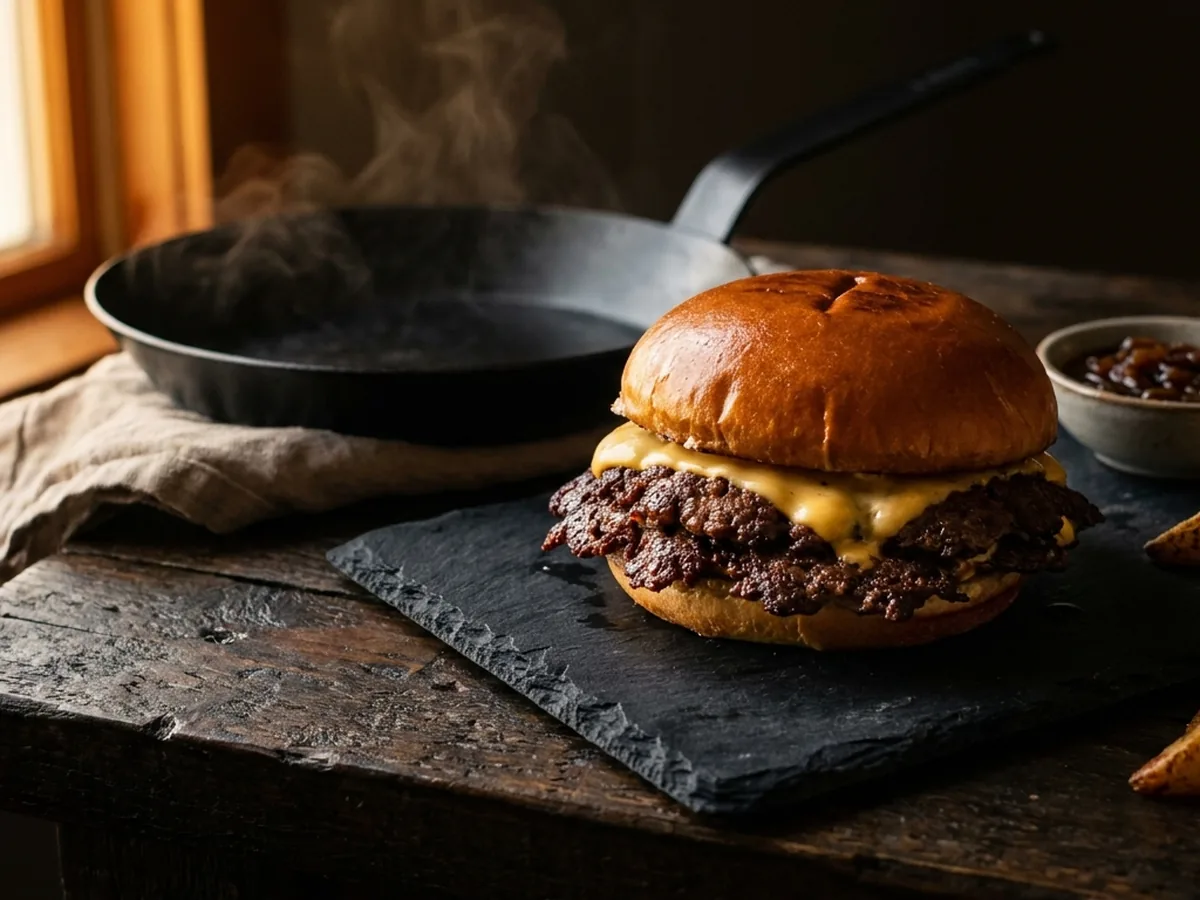
A crust taken further than feels comfortable, on a soft sweet roll, with ShackSauce underneath. Twelve minutes.
 food.fast
Takeaway taste, kitchen prices
Press at Ten Seconds and You Get Lace. Press at Forty and You Get Juice on the Hob
The smashburger is one technique with one critical timing. Here is what is happening at the surface of the meat, why the window is so short, and how to hit it.
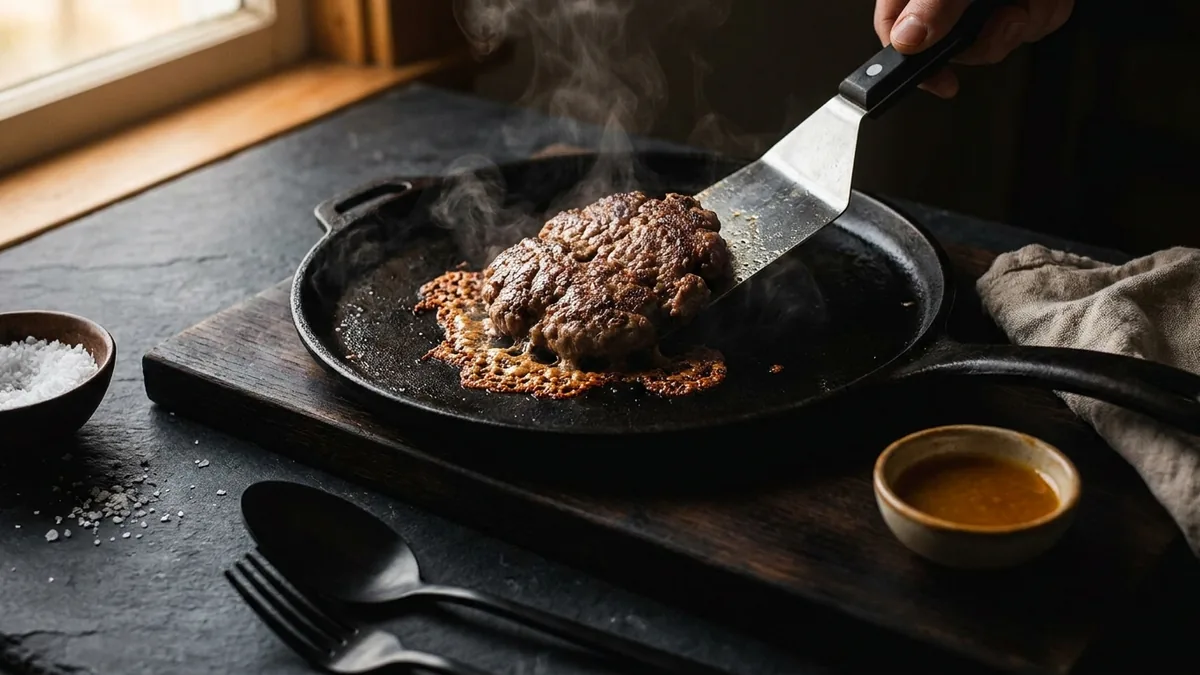
When a ball of cold mince meets a 230 °C surface, several things start at once.
Water at the contact surface flashes to steam and leaves. Proteins denature and begin to link to each other, forming a solid layer. And once the surface is dry enough - above about 140 °C - the Maillard reaction begins: amino acids and reducing sugars combining into the hundreds of compounds that make browned meat taste of browned meat.
For the first few seconds the meat is still plastic. Press it and it spreads, pushing fresh raw surface into contact with the metal, which maximises the contact area and therefore the total browning.
By about ten seconds the protein layer has set. The patty is no longer plastic; it is a solid object with a crust. Pressing now does not spread it - it compresses it vertically and forces liquid out through the sides.
That liquid is what you wanted in the patty. This is why a smashburger pressed late is both dry and poorly crusted: you lose the juice and you never got the surface area.
One press, hard, immediately. Then leave it alone for ninety seconds.
The single most common reason a home smashburger fails is that the pan is not hot enough - and specifically, that it does not stay hot enough.
A domestic hob can heat a thin pan to 230 °C. But the instant a cold 70 g ball of beef lands on it, that pan surrenders its heat to the meat and its temperature collapses. A thin non-stick pan can drop forty degrees in seconds and then sit there, because the hob cannot put energy back in fast enough through a thin base.
Below about 140 °C the Maillard reaction effectively stops and the meat steams instead. Grey, not brown.
The answer is mass. A 3 mm cast iron or carbon steel pan stores far more energy than a 1.5 mm aluminium one, so the same patty barely dents it.
Practical rules:
A commercial flat-top is a 25 mm steel plate held at temperature by a burner underneath. You cannot match that, but a heavy pan gets meaningfully close, and this is the equipment purchase most worth making.
Salt applied to raw meat and left dissolves surface proteins - principally myosin - and draws moisture out. Given time, that moisture reabsorbs, carrying salt with it, which is what dry brining is and why it is good for a steak.
For a smashburger, the timing is wrong in two ways.
Wet surface. Salt draws water out within minutes. Water at the surface has to boil off before browning can start, so a salted-in-advance patty spends its first thirty seconds steaming.
Dissolved myosin makes a bouncy crust. Dissolved myosin sets into a springy gel - exactly the mechanism that makes nuggets and sausages springy. In a burger that reads as sausage-like rather than loose and beefy.
So: form the ball unseasoned, smash it, then salt the upward face while it cooks. Salt the second side after the flip.
The same logic explains why nothing is mixed into a chain burger patty. Egg, breadcrumb, onion and Worcestershire all turn a burger into a rissole, which has a uniform, springy texture. Chain patties are beef, salt and pepper.
The two things that go wrong:
Leaving the crust in the pan. The spatula goes in at too steep an angle and shaves the patty off its own crust. Go in almost flat, under the whole thing, and scrape rather than lift. And give it the full ninety seconds - a properly set crust releases itself.
Smoke. This is a 230 °C pan with beef fat on it and it will smoke. Extractor on, window open. If your extractor is weak, this is a recipe for a cast iron plate on a barbecue, which solves it entirely and gets hotter than a domestic hob besides.
A crust taken further than feels comfortable, on a soft sweet roll, with ShackSauce underneath. Twelve minutes.
Two thin patties, a three-piece bun and the assembly order that stops the whole thing sliding apart on the second bit…
Two smashed patties by default, no seasoning in the meat, and a free-for-all of toppings. Fifteen minutes.