Starbucks
Starbucks Vanilla Sweet Cream Cold Brew Copycat Recipe
Coffee steeped in cold water for sixteen hours, and a frothed vanilla cream that cascades through it. Five minutes of work.
 food.fast
Takeaway taste, kitchen prices
Why Cold Foam Has to Be Non-Fat and Hot Foam Does Not
Steamed milk, microfoam and cold foam depend on different things, and the rules for one actively break the other. Here is what is happening in each.
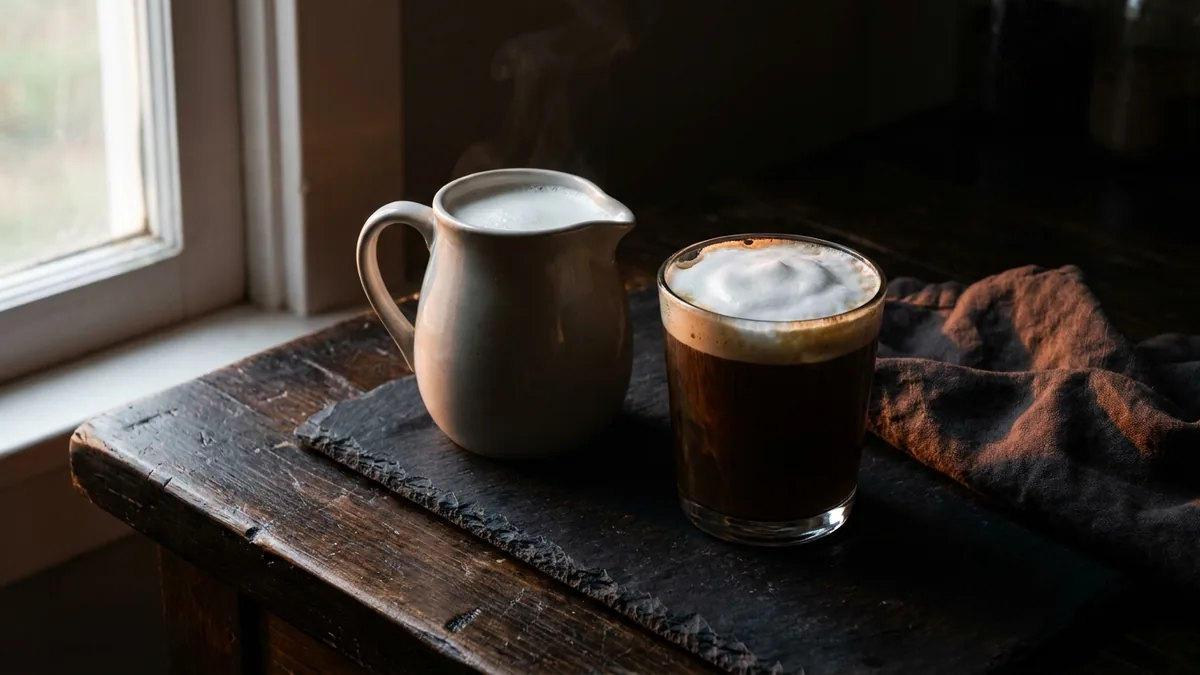
Foam is gas bubbles trapped in a liquid. What stops them merging and collapsing is a film of surface-active molecules around each bubble.
In milk, that job is done by proteins - principally whey proteins and casein. When milk is agitated, proteins unfold at the air-water interface and link to each other, forming an elastic skin around each bubble.
Fat works against this. Fat globules displace proteins at the interface and destabilise the film, and free fatty acids actively break foams. This is why whole milk foam collapses faster than skimmed milk foam, and why a trace of grease in a jug can stop milk foaming entirely.
So the general rule is: protein builds foam, fat breaks it.
Which raises an obvious question - why does whole milk make better cappuccinos? The answer is that hot and cold foaming are different situations, and the next two sections cover why.
When milk is heated, whey proteins denature - they unfold - which makes them substantially better at forming the elastic films that stabilise bubbles. Heat is actively helping.
That extra stabilising capacity is enough to overcome the destabilising effect of the fat, which is why whole milk steams into a glossy, stable microfoam that lasts several minutes, while skimmed milk makes a stiffer, drier, more meringue- like foam that separates quickly.
The temperature ceiling is around 65 to 68 °C. Above that:
Technique for a domestic frother or steam wand:
Cold foam gets no help from denatured proteins, because nothing has been heated. The proteins have to do the job in their native state, and the fat is working against them the whole time.
Which is why cold foam needs skimmed or very low-fat milk. Whole milk simply will not hold a cold foam for more than a few seconds.
The method: fridge-cold skimmed milk, a little syrup for sweetness and body, thirty seconds with a handheld frother. It should thicken visibly and hold soft ripples.
Vanilla sweet cream - the thing that goes on a cold brew - is a related but different product. It is two parts cream to one part milk, frothed cold, and it works because of the fat rather than in spite of it: at high fat concentrations the fat globules partially coalesce into a network, which is the same mechanism as whipped cream. It does not make a stable microfoam; it makes a thick, pourable cream that cascades through the coffee, which is the point.
So there are two cold techniques and they are opposites: skimmed milk for foam that sits on top, high-fat cream for a pour that falls through.
Plant milks have little or no casein, so they foam by entirely different means - usually added proteins, gums and emulsifiers. Which is why "barista" versions exist and ordinary versions frequently do not work.
| Milk | Hot foam | Cold foam | Notes |
|---|---|---|---|
| Barista oat | Excellent | Good | The best plant option; added protein and stabiliser |
| Standard oat | Poor | Poor | Thin, and splits in hot coffee |
| Soy, barista | Very good | Good | Highest natural protein; can curdle in acidic coffee |
| Almond | Poor | Poor | Very low protein |
| Coconut | Poor | Fair | Foams from fat, not protein |
| Pea protein | Good | Good | High protein, distinctive flavour |
Curdling in hot coffee is a separate problem from foaming. It happens when coffee's acidity destabilises plant proteins, and it is worse with hot, acidic, lightly-roasted coffee. Three fixes: use a barista formulation, pour the coffee into the milk rather than the other way round, and use a darker roast, which is less acidic.
Barista oat milk is the most reliable all-round option and its natural sweetness suits flavoured drinks particularly well.
Coffee steeped in cold water for sixteen hours, and a frothed vanilla cream that cascades through it. Five minutes of work.
Vanilla syrup, milk, espresso poured last so it marks the foam, and a caramel drizzle. Two minutes once the syrup is made.
A pumpkin spice sauce made in fifteen minutes that keeps two weeks, and the drink built from it in ninety seconds.