Five Guys
Five Guys Cajun Fries Copycat Recipe
Skin-on potatoes, fried twice at two temperatures, tossed hot in Cajun seasoning. The oil is doing more of the flavou…
 food.fast
Takeaway taste, kitchen prices
Smoke Point, Flavour and Cost - and Why They Point Different Ways
Most frying oils are interchangeable on paper and not in practice. Here is what actually differs, what to use for what, and how to tell when oil has had enough.
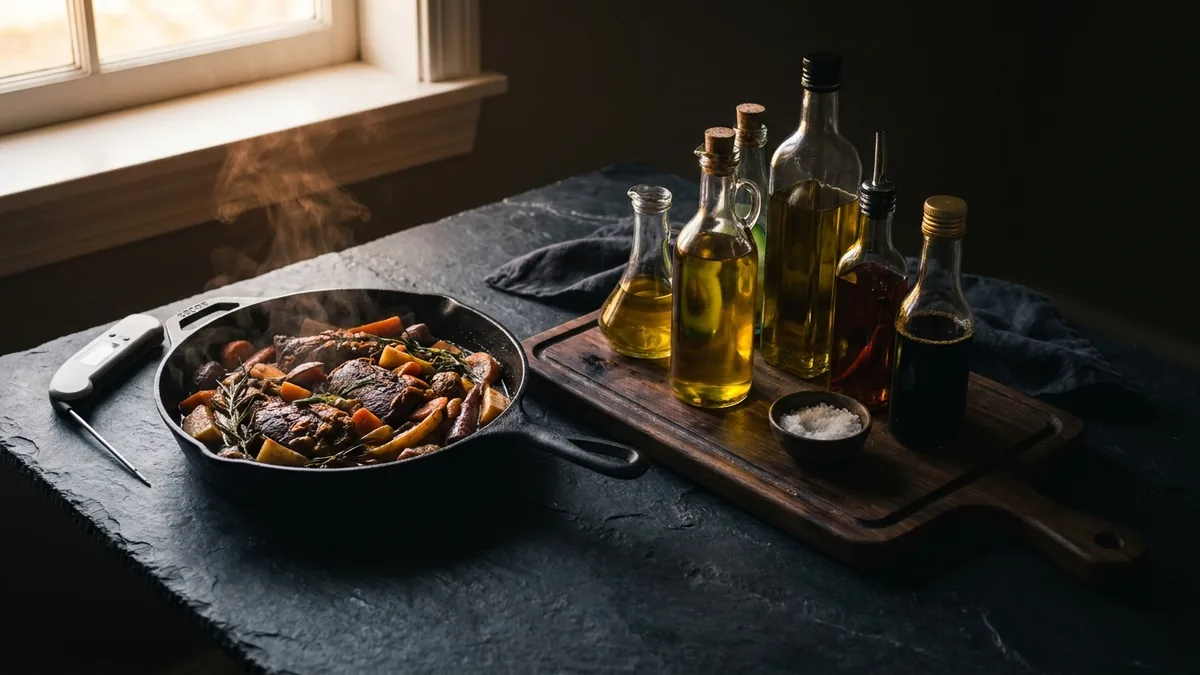
The smoke point is where an oil starts to break down visibly. Past it the oil develops acrid flavours, produces more free radicals and polar compounds, and is closer than you want to its flash point.
Frying happens at 160 to 190 °C, so you want something comfortably above.
| Oil | Smoke point | Cost | Flavour | Verdict |
|---|---|---|---|---|
| Refined rapeseed | 230 °C | Low | Neutral | The default |
| Groundnut / peanut | 230 °C | Medium | Nutty | Best flavour for chips |
| Sunflower, refined | 225 °C | Low | Neutral | Fine |
| Vegetable blend | 220 °C | Lowest | Neutral | Fine, varies |
| Beef dripping | 205 °C | Medium | Beefy | Superb for chips |
| Light olive oil | 200 °C | High | Mild | Works, expensive |
| Coconut, refined | 205 °C | High | Slight | Works, flavour transfers |
| Extra virgin olive | 190 °C | High | Strong | No |
| Butter | 150 °C | - | - | No, the milk solids burn |
Smoke point falls with use. Every session introduces food particles and water, both of which accelerate breakdown, and each cycle of heating produces free fatty acids that lower the smoke point further. Oil that starts smoking at a temperature it handled fine last month has degraded and should go.
Chips. Peanut or groundnut oil, if you can. It has a genuine nutty note that is part of why Five Guys chips taste the way they do, and the company says so on the wall. Beef dripping gives an excellent and entirely different British chip-shop result.
Fried chicken. Anything neutral with a high smoke point. Rapeseed or vegetable oil. The seasoning is doing the flavour work and an oil with character fights it.
Doughnuts and sweet frying. Neutral, and keep it separate from savoury oil afterwards - it picks up sugar and vanilla and will flavour the next batch of chips.
Shallow frying and pan work. Whatever you have. The volumes are small enough that cost and reuse matter much less.
What to avoid across the board: extra virgin olive oil, which smokes below frying temperature and is a waste of an expensive ingredient; butter, whose milk solids burn at 150 °C; and any unrefined or cold-pressed oil, which has a much lower smoke point than its refined equivalent.
On nut allergies: if peanut oil is out, refined rapeseed plus a tablespoon of toasted sesame oil per litre stirred in after cooling gets you a comparable nutty top note. It is not the same and the recipes say so.
Reusing frying oil is normal and economical. The limits depend entirely on what you fried.
Strain it warm, not hot - through a fine sieve lined with muslin or a coffee filter, into a clean sealed container, stored somewhere dark and cool. Light and air are what degrade it between uses.
The five signs it should go, any one of which is enough:
Foaming is the most reliable one. It means the oil has polymerised enough to hold bubbles, which is a fairly late stage of degradation.
Never pour cooking oil down a sink or a drain.
Oil cools and solidifies in pipes, and combines with wet wipes and other solids to form the fatbergs that block municipal sewers. UK water companies spend tens of millions a year clearing them, and a domestic pipe blocked with congealed fat is an expensive plumbing bill.
What to do:
Small quantities - a tablespoon or two from a pan - can be wiped out with kitchen paper and binned.
Never put it in food waste collections or compost, where it attracts vermin and interferes with the composting process.
Wait for it to cool completely in the pan before pouring or straining. Carrying hot oil across a kitchen is one of the most common causes of serious domestic scalds.
Skin-on potatoes, fried twice at two temperatures, tossed hot in Cajun seasoning. The oil is doing more of the flavou…
Buttermilk brine, a double dredge with a rest, and controlled shallow frying. Honest about the one thing a home kitch…
A very soft enriched dough, a short proof, forty-five seconds a side, and a thin glaze applied immediately. The heat …