Wendy's
Wendy's Chili Copycat Recipe
Beef browned hard and broken into chunks rather than crumbled, a sweet tomato-juice base, and two kinds of bean. Nine…
 food.fast
Takeaway taste, kitchen prices
Containers, Labels and a Freezer That Is Not a Mystery Drawer
Batch cooking fails on storage more often than on cooking. Here is the small amount of infrastructure that makes it actually happen.
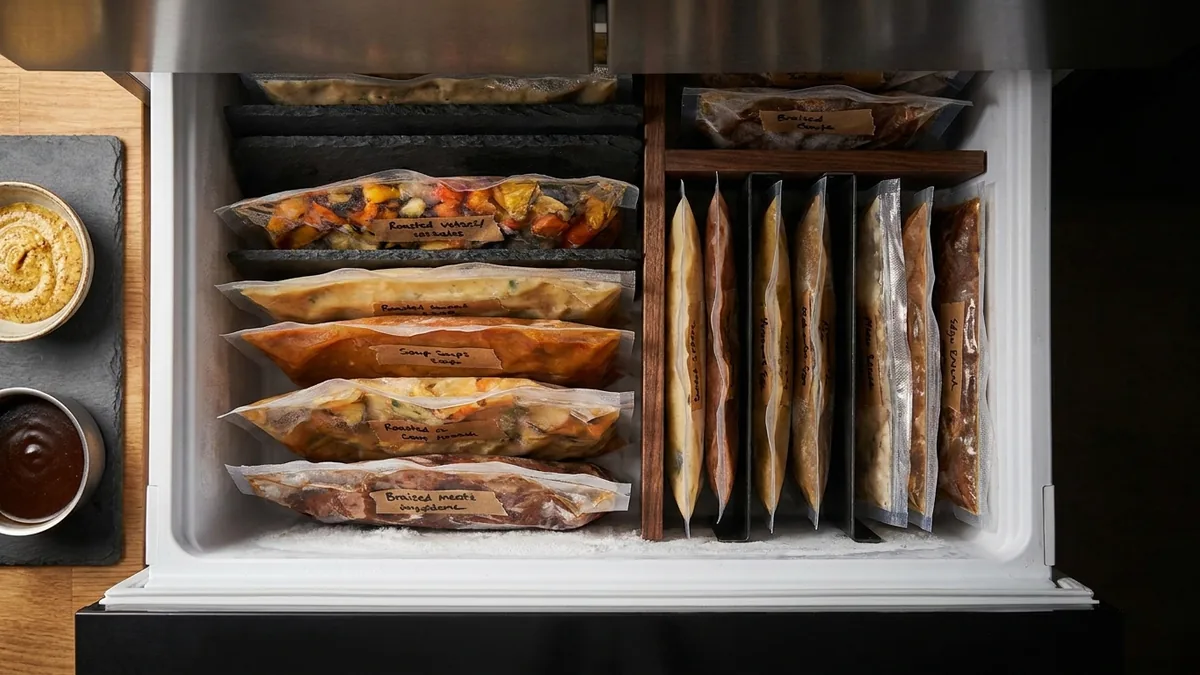
Space. A litre of chili in a flat frozen bag occupies roughly a third of the volume of the same litre in a tub, because a tub is mostly air and wall. A freezer drawer holds three times as many meals.
Thawing speed. A flat bag is perhaps 2 cm thick; a tub is 10. Heat travels from the surface inward, so a flat bag thaws in a bowl of cold water in forty minutes where a tub takes a day in the fridge. This is the difference between deciding to eat something at five o'clock and deciding yesterday.
Filing. Flat frozen bags stand on edge like books. You can see every label at once, which is what stops a freezer becoming a geological deposit.
How to do it: fill the bag, press the air out, seal, lay flat on a tray until solid - a few hours - then stand it on edge in a drawer.
Where tubs are still right: anything delicate that would be crushed, anything you will reheat directly in the container, and anything liquid enough to leak.
Vacuum sealers are genuinely better for long storage - no air means no freezer burn - and are a luxury rather than a necessity. A bag with the air pressed out is 90 per cent as good.
The single biggest quality lever in batch cooking, and it is about how many times the food gets heated.
Reheating is the most damaging step in the whole process - proteins tighten, starches retrograde, textures coarsen. The second reheat of the same food is noticeably worse than the first.
Freeze eight portions in one block and the sequence is: thaw all eight, eat two, refrigerate six, reheat them again over the following days. Everything after the first meal has been heated twice.
Freeze in the unit you will actually eat and nothing is ever heated more than once.
Practical sizing:
The chili at 2× gives sixteen portions. Eight bags of two, not one large tub.
A freezer full of anonymous brown blocks is a freezer that gets emptied into a bin once a year. This is not a discipline problem, it is an information problem.
On every label:
Masking tape and a marker works and is cheap. Freezer labels are better and peel off cleanly.
Write on the bag before you fill it. Writing on a full, cold, damp bag does not work.
Rough quality windows, which is why the date matters. Everything is safe indefinitely at −18 °C; these are about when it stops being nice:
| Food | Best within |
|---|---|
| Stews, chili, sauces | 3-4 months |
| Cooked meat | 2 months |
| Raw mince and formed patties | 3 months |
| Bread and doughs | 3 months |
| Par-fried chips and nuggets | 3 months |
| Compound butters | 3 months |
Batch cooking depends less on equipment than on not having to shop for six things before you can start.
The six that unlock most of this site, covered in cost per portion and worth repeating:
White pepper, celery salt, smoked paprika, MSG, sodium citrate and a tin of chipotles in adobo. Under £15 total and all of them last months to years.
Plus the ordinary things worth having in quantity:
One habit worth adopting: the moment you open a tin of chipotles in adobo, blitz the whole tin and freeze it as cubes. One cube is one chilli's worth. It turns a specialist purchase into a store cupboard staple and stops you buying a tin, using two chillies and throwing the rest away.
Beef browned hard and broken into chunks rather than crumbled, a sweet tomato-juice base, and two kinds of bean. Nine…
The component that unlocks the whole menu. Oats cooked into the mince and enough water to make a paste - which is the…
A pressed rather than tossed dough, cold-fermented for two days. Fifteen minutes of work, and the fridge does the rest.
A sage-heavy sausage patty, an egg cooked in a ring, and a properly toasted muffin. Fifteen minutes, and better than …