Pizza Hut
Pizza Hut Pan Pizza Copycat Recipe
Three tablespoons of oil in the tin, a dough that proves where it bakes, and a base that fries from underneath. The o…
 food.fast
Takeaway taste, kitchen prices
Domestic Ovens Vary by 25 Degrees From Their Own Dials
A recipe that works everywhere except your kitchen is usually a thermostat problem. Here is how to find out what your oven actually does and how to work around it.
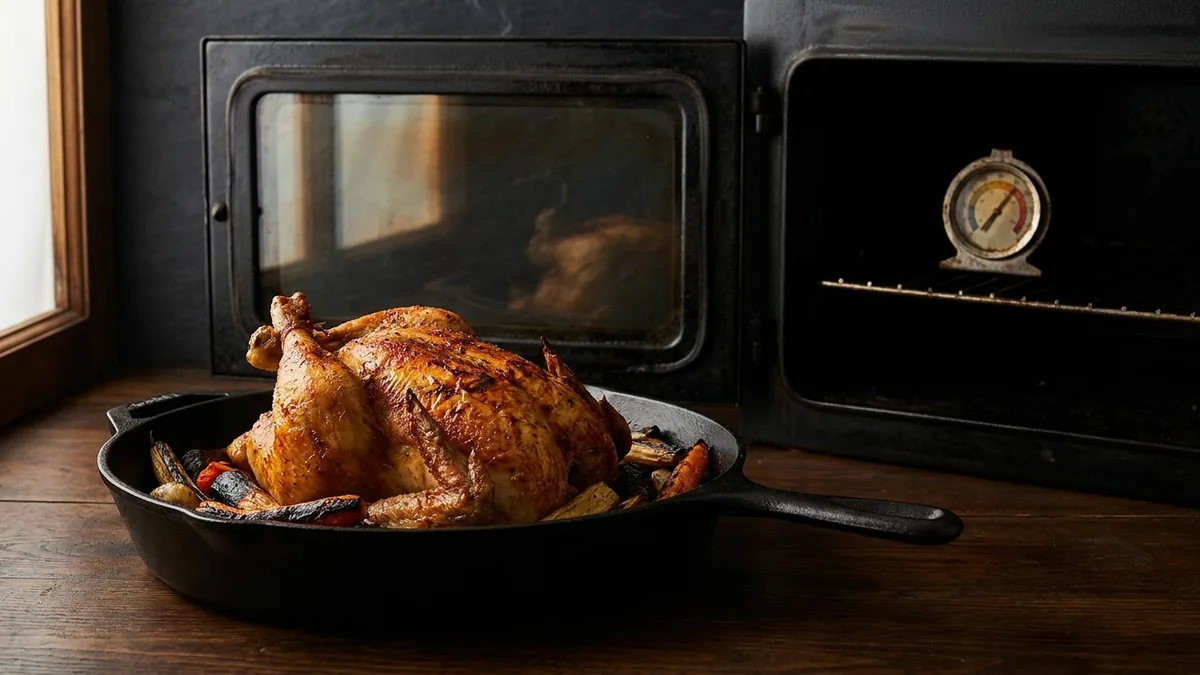
A domestic oven thermostat does not hold a temperature. It cycles - the element comes on, the cavity overshoots the set temperature, the element goes off, the cavity falls below it, and the cycle repeats. The swing is commonly 20 to 30 °C either side of the setting.
On top of that cycling, the calibration itself drifts. Ovens age, door seals perish, and thermostats were not precisely calibrated when new. Testing across domestic ovens routinely finds them running 10 to 25 °C away from the dial, in either direction.
What that means in practice:
None of this is fixable by being more careful. It is fixable by knowing the number.
Buy an oven thermometer. The hanging dial kind costs about five pounds and it is the cheapest useful thing in this hub.
The test:
What to do with the number. If your oven reads 165 when set to 180, it runs 15 °C cold. Set it 15 degrees higher than every recipe says, permanently. Write it on a sticker inside a cupboard door.
Test at two temperatures - 150 and 220 - because the error is often not constant across the range.
The hot spot test: cover an oven shelf with slices of white bread and toast them at 220 °C for six minutes. The pattern of browning maps your oven's hot spots exactly. Most ovens have one back corner that runs noticeably hotter, which is why rotating a tray halfway through is worth doing.
A fan circulates hot air, which strips away the insulating boundary layer of cooler air against the surface of the food. That moves heat into the food faster at the same air temperature.
The standard adjustment is 20 °C: a fan oven at 160 °C cooks roughly like a conventional oven at 180.
Every recipe on this site prints both, plus gas mark, and the oven converter has the full table.
Where the rule holds: almost everything. Roasting, most baking, anything where even heat and browning are wanted.
Where it does not:
Fan ovens also dry things out faster, which is why an air fryer - a very aggressive fan oven - is superb for chips and poor for a plain chicken breast.
1. Preheat longer than the light says. Twenty minutes minimum for ordinary baking; forty-five for a pizza stone or steel, which has to reach temperature all the way through. The ready light tells you the air is hot, not the cavity.
2. Rotate the tray halfway. The single easiest correction for hot spots and it costs nothing.
3. Do not open the door. Every look drops the cavity temperature by 25 to 50 °C and it takes several minutes to recover. Use the light and the window.
4. Use the visual cues in the recipe, not the clock. Every recipe on this site describes what the food should look like - "deep golden and the edges lacy", "the middle still looks wet" - because that is transferable between ovens where a number is not.
5. Probe the internal temperature where it matters. 74 °C for chicken, 93 °C for bread, 71 °C for beef mince. These do not vary between ovens, which is exactly why they are the most useful numbers in any recipe.
The last one is the real answer. An oven thermometer tells you what your oven is doing; a probe tells you what the food is doing, and the food is what you are actually cooking.
Three tablespoons of oil in the tin, a dough that proves where it bakes, and a base that fries from underneath. The o…
An enriched dough, a filling that is a third cinnamon by volume, and a cream cheese frosting with a much higher chees…
A soft honey-and-molasses wheat loaf coloured with cocoa, rolled in oats. Two and a half hours, mostly rising.
Grated frozen butter, a folded dough, and a cutter pressed straight down. Twenty-five minutes from a standing start.